Woke rating
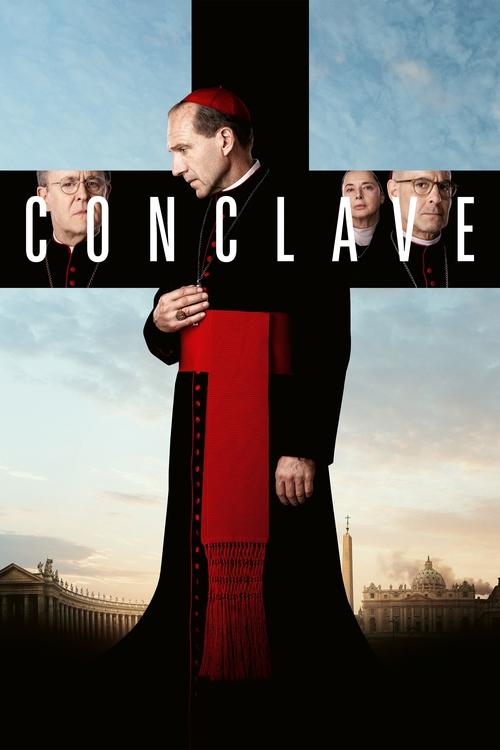
Conclave
Moderate
A papal thriller whose liberal-versus-traditionalist politics giveand late intersex twist give it a clear progressive slant, though it keeps its sermons in character and does not flatter its liberal side.
Edward Berger's adaptation of Robert Harris's novel follows Cardinal Lawrence (Ralph Fiennes), the dean who must run the election of a new pope after the old one dies. Most of the film is a procedural: ballots, vote counts, corridors and secrets that knock the favourites out one by one.
The factions are drawn on modern political lines. Bellini is the liberal who wants a softer line on gay people and divorce and more women in the Curia. Tedesco is the traditionalist who misses the Latin Mass. Adeyemi is socially conservative. Lawrence's homily against certainty sets out the film's thesis, and the last act puts that thesis to the test in ways that push the score up.
The factions are drawn on modern political lines. Bellini is the liberal who wants a softer line on gay people and divorce and more women in the Curia. Tedesco is the traditionalist who misses the Latin Mass and, after bombs go off in Rome, calls for a religious war. Adeyemi is socially conservative and sinks over a decades-old affair. Lawrence's homily against certainty sets out the film's thesis, and Benitez, an unknown archbishop from Kabul, wins the vote with a speech saying the real enemy is the hatred inside each cardinal. The last scene reveals that Benitez is intersex and chose not to have surgery, and the film presents this as a strength.
What keeps the score in the moderate band is that the messaging mostly stays inside the story. A conclave is a place of sermons, so the speeches are motivated. The liberal side is not flattered: its leaders are vain and ambitious tooBellini is ambitious and backs down when it counts, and Lawrence himself has picked a papal name. The plot runs on ordinary intrigueordinary corruption, vote-buying and scandal, not on identity, and one cardinal openly points out his liberal colleagues' racial double standard.
Score breakdown
Each category is scored 0 to 3: 0 absent or presence only, 1 brief, 2 recurring or plot-relevant, 3 central or dominant. Timestamps refer to the film's running time.
| Category | Score | What we saw |
|---|---|---|
| Content | ||
| A Race and ethnicity | 1 | Race comes up briefly, as voting-bloc arithmetic and in one exchange about Adeyemi's chances as the first African pope.
|
| B Gender and feminism | 2 | Women's place in the Church recurs: the nuns are shown serving silently, and women later become central to the plot, one of them turns the election, and a young woman's abuse by an older cleric is a plot point.
|
| C Sexuality and gender identity | 2 | Gay rights mark the factions, and a late revelation about one character's body is presented sympathetically, with no voice raised against it, and the closing twist is the new pope's intersex body, presented sympathetically with no voice raised against it. Scored 2, not 3: it arrives in the last fifteen minutes as a reveal, and Benitez rejects surgery rather than seeking a change of sex.
|
| D Power and systems | 1 | The Curia is shown as political and power-hungrycorrupt and power-hungry throughout, but as a critique of ambition and vote-buying rather than oppression of a group.
|
| E Cultural and historical revision | 0 | A faithful adaptation of Robert Harris's 2016 novel, with the same ending. No established characters or history are recast. |
| F Religion portrayal | 1 | Islam itself is never portrayed. One late scene argues against treating Muslims as the enemy, and it matters to the outcome and the bombers are not named, but the film's turning point rebukes the call for a war of religion after the attacks, and that rebuke wins the papacy.
|
| Treatment | ||
| G Antagonist coding | 2 | The main ideological foe, Tedesco, is defined by his traditionalism and shown as crude and warlike, with little personal motive. The other rivalsantagonists have individual motives (Tremblay's ambition, Adeyemi's past), and the liberal Bellini is flawed too.
|
| H Didacticism | 2 | Several speeches state the message directly, though each is a sermon or address the setting calls for.
|
| I Message over story | 1 | The story mostly leads, but the ending stacks convenient turns toward the message: a bomb, one speech that flips the vote, then the reveal. The twist is set up in advance.
|
| J Left-leaning politics framed as good | 2 | The reform-minded camp is framed as the Church's hope and the traditionalists as the threat, and a reformer wins. The film does not make the liberals saints.
|
How the number is reached
- Categories A to J add up to 14 of 30, which gives 4.5 (14 ÷ 30 × 10, rounded to the nearest 0.5).
- Counterweight −0.5: the film complicates its own side: the liberal favourite and Lawrence himself are both shown as ambitious and flawed, a cardinal calls out liberal colleagues' racial double standard (0:58:10), and the conservative rivals get personal motives.the liberal favourite Bellini lacks the courage to act on the simony report (1:25:43) and admits his own ambition (1:31:00); Lawrence breaks the papal seals (1:24:10) and has privately chosen the name John (1:31:54); a cardinal calls out liberal colleagues' racial double standard (0:58:10); and Adeyemi is given a personal motive and treated with compassion (1:03:24, 1:04:34).
- Final rating 4.0, moderate.
Without category F (religion), the total is 13 of 30, giving 4.5, and 4.0 after the counterweight (moderate).
Considered, scored 0
- A college of cardinals from Africa, Asia, Latin America and Europe, shown without comment.
- Benitez's Mexican background and Adeyemi's Nigerian origin, as such.
- No romantic or sexual relationships are shown on screen.
Evidence and confidence
Confidence: Medium. Full English subtitles, and 120 frames sampled once a minute plus about 30 targeted frames around the key scenes. Both English subtitle tracks skip about two minutes of dialogue late in the film (Tedesco's Italian outburst and part of Benitez's reply after the bombing) (1:36:30 to 1:38:50); that stretch was transcribed from the audio.
Category F definition: As in the rubric: Islam shown as a peaceful and tolerant religion, aligned with human rights, in a way that works as a corrective message.
Noted, not scored: Some points cut the other way: a cardinal accuses liberals of a racial double standard over Adeyemi (0:58:10), and Benitez rejects surgery as changing God's handiwork (1:50:03), a view closer to traditional teaching than to gender ideology.
Rubric version 1. Reviewed 17 November 2026.