Woke rating
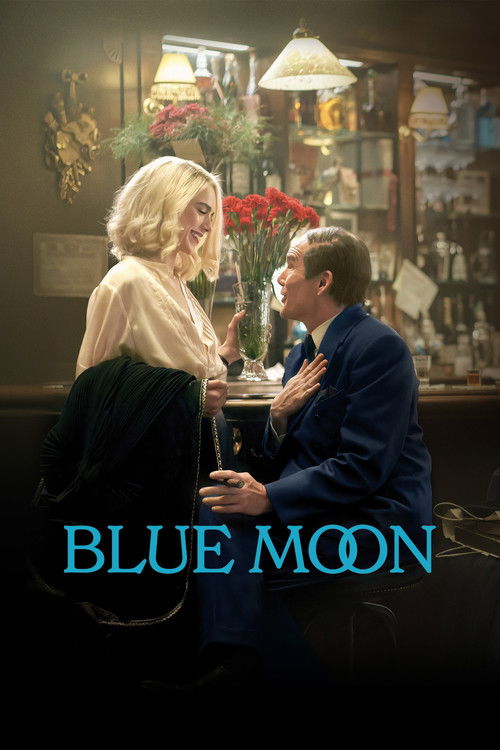
Blue Moon
None or negligible
A talky one-night portrait of lyricist Lorenz Hart in which his ambiguous sexuality runs through the banter as part of the character, not as a cause; there is almost no identity or political messaging.
Richard Linklater's chamber drama takes place almost entirely in Sardi's bar on 31 March 1943, the night Oklahoma! opens. Lorenz Hart (Ethan Hawke), Richard Rodgers's lyricist for more than twenty years, drinks against his doctors' advice, holds court with the bartender, a young pianist and E.B. White, and waits for Elizabeth Weiland, a 20-year-old Yale art student he adores, while Rodgers celebrates his first hit with a new partner.
Hart's sexuality is the only identity theme. He calls himself 'ambisexual' and says a writer has to carry everyone inside him, men and women alike (0:09:47), tells gay jokes at his own expense, and cuts the bartender off when he hints that Hart's interests lie elsewhere (0:17:14). Late in the night the question comes back to himLate in the night Elizabeth admits her mother doubts that his primary interest is women (1:24:00), and he answers that he is drunk with beauty wherever he finds it, in men and in women (1:25:02). The film treats this sympathetically, as part of his loneliness, but never turns it into an argument.
Nothing else registers. The central quarrel is artistic and personal: Hart sneers at Oklahoma!'s corn-pone Americana, and Rodgers answers that audiences recognised love, family and pride in their country in it, with the reviews and the crowd on his side (0:47:09, 1:00:04). Race comes up only in period jokes, the anti-war remarks are a brief musing, and there are no villains.
Score breakdown
Each category is scored 0 to 3: 0 absent or presence only, 1 brief, 2 recurring or plot-relevant, 3 central or dominant. Timestamps refer to the film's running time.
| Category | Score | What we saw |
|---|---|---|
| Content | ||
| A Race and ethnicity | 0 | No racial theme. A crude joke about cannibals singing Porgy and Bess (0:44:10) and running gags about Jewish names in show business are period banter with no message. |
| B Gender and feminism | 0 | Elizabeth is clever and frank about her love life, but her story is told as ordinary heartbreak, not as a point about women or men. |
| C Sexuality and gender identity | 1 | Hart's ambiguous sexuality recurs as part of his character and resurfaces in the last act, framed sympathetically. It scores 1, not more: it is voiced only by Hart himself, in jokes and self-description, and never argued as a cause.
|
| D Power and systems | 0 | No critique of institutions as oppressive. Brief remarks on the First World War's death toll (0:30:39) are a personal musing, and the young soldier in the bar calls himself a patriot (0:31:02). |
| E Cultural and historical revision | 0 | A portrait of real people on a real night. No established characters are recast by sex or ethnicity, and Hart's sexuality is not presented as a revision of history. |
| F Religion portrayal | 0 | Islam does not appear. |
| Treatment | ||
| G Antagonist coding | 0 | There are no villains. Rodgers is Hart's rival for the night but is given a full and sympathetic hearing. |
| H Didacticism | 0 | Hart talks almost without pause, but his monologues are about songwriting, love and himself, not lectures on a social message. |
| I Message over story | 0 | The story leads throughout; nothing bends toward a message. |
| J Left-leaning politics framed as good | 0 | No left- or right-coded politics. Hart's scorn for Oklahoma!'s nostalgia is an aesthetic quarrel, and the other side wins the argument on its own terms. |
How the number is reached
- Categories A to J add up to 1 of 30, which gives 0.5 (1 ÷ 30 × 10, rounded to the nearest 0.5).
- No counterweight: None needed: the only scored element is Hart's own sympathetic but unargued description of himself, and there is no wider message for the film to complicate.
- Final rating 0.5, none or negligible.
Considered, scored 0
- Elizabeth's account of her love life and her remark that she is smarter than most college boys (1:07:20), told as heartbreak rather than as a point about women.
- Period jokes about race and Jewish identity: cannibals singing Porgy and Bess, which Rodgers waves off (0:44:10), a pianist who changed his name (0:11:07), and an MGM boss who did the same (1:33:06).
- Anti-war musing about the First World War (0:30:39), not framed as oppression or as a political side.
- No interracial or same-sex couple is shown in the dialogue or the sampled frames.
Evidence and confidence
Confidence: Medium. Full English subtitles (embedded track) and 100 frames sampled once a minute. The subtitles cover all the dialogue up to the closing credits; no gaps were found.
Category F definition: As in the rubric: Islam shown as a peaceful and tolerant religion, aligned with human rights, in a way that works as a corrective message.
Noted, not scored: Rodgers's defence of Oklahoma! as a show about love, family and pride in country (0:47:09), with the critics and the 1,600-strong audience behind him (0:55:45, 1:00:04), gives sentimental, patriotic Americana a fair and winning hearing against Hart's cynicism.
Rubric version 1. Reviewed 18 November 2026.