Woke rating
Bad Apples
None or negligible
A pitch-black school comedy about a teacher, a violent pupil and a community that would rather look away; its only scored points are an interracial couple shown without comment and a light satire of exam-driven schooling.
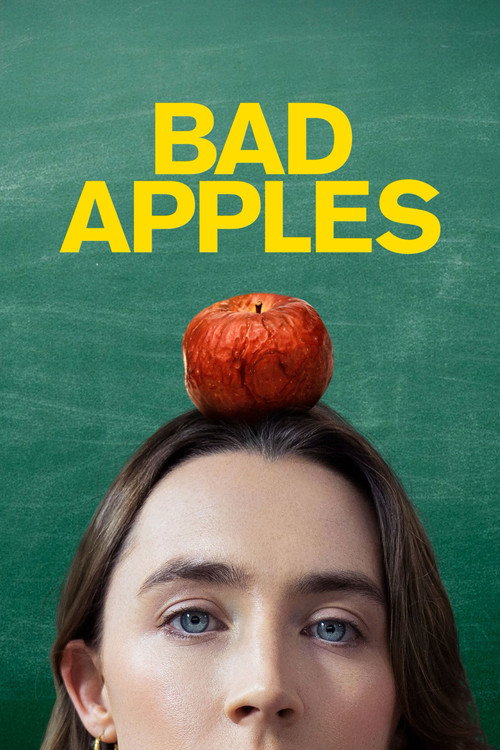
Jonatan Etzler's black comedy thriller follows Maria Spencer (Saoirse Ronan), a primary school teacher in the West Country whose class is wrecked by Danny, a foul-mouthed, violent boy. After he pushes a classmate down the stairs and a night-time struggle leaves him threatening to tell everyone she attacked him, Maria locks him in her basement. With Danny gone, her class and her career start to flourish, and the film follows how far she, and the people around her, will go to keep it that way.
Most of what the rubric counts is incidental. Maria's ex-partner Sam, a fellow teacher, is Black, and their break-up and its aftermath recur through the film. The satire is aimed at a school that runs on Ofsted grades and SATs results: the head will not pay for help with Danny, the inspection matters more than the boy, and Danny turns out to be neglected at home and unable to write. The last act turns the satire on the parents.
Most of what the rubric counts is incidental. Maria's ex-partner Sam, a fellow teacher, is Black; their break-up recurs through the film, and they end up together again. The satire is aimed at a school that runs on Ofsted grades and SATs results: the head will not pay for help with Danny, the inspection matters more than the boy, and Danny turns out to be neglected at home and unable to write. When the truth comes out, the parents argue for keeping Danny locked up so their children can sit their SATs, Sam becomes head and makes Maria his deputy, and the film ends with a scholarship in Danny's name.
The score stays at the bottom because the film argues no identity politics. The couple is shown without comment, and the school satire spares no one: teachers, parents and inspectors all put their own comfort first. Every side gets a motive. Danny is genuinely violent, the parents fear for their own children, and Maria is no heroine. The film's interest is in how ordinary people talk themselves into cruelty, not in race, gender or politics.
Score breakdown
Each category is scored 0 to 3: 0 absent or presence only, 1 brief, 2 recurring or plot-relevant, 3 central or dominant. Timestamps refer to the film's running time.
| Category | Score | What we saw |
|---|---|---|
| Content | ||
| A Race and ethnicity | 2 | An interracial couple, counted as the rubric requires: Maria and her ex-partner Sam, a Black teacher at her school, whose break-up recurs through the filmrecurs through the film and who end up together again. Scored 2 as a recurring supporting couple; race itself is never mentioned.
|
| B Gender and feminism | 0 | The story centres on a woman teacher and the school is run by a headmistress, but no point is made about gender. |
| C Sexuality and gender identity | 0 | No LGBTQ content. |
| D Power and systems | 1 | The school and its community are satirised for putting results, inspections and their own comfort ahead of a neglected, violent boy, to the point of voting to keep him locked up. The target is everyone's self-interest, not an institution oppressing a group.
|
| E Cultural and historical revision | 0 | No established characters or history are recast. |
| F Religion portrayal | 0 | Islam does not feature, and religion plays no part in the story. |
| Treatment | ||
| G Antagonist coding | 0 | There is no villain group. Danny is violent but given a neglected home life, and the parents who close ranksvote to keep him locked up are a mixed crowd with real motives: Frank's daughter's broken arm, Khaliya's bullying. |
| H Didacticism | 0 | No one lectures. Maria's outburstsconfession and the parents' arguments are about the case in front of them, not a political message. |
| I Message over story | 0 | The plot runs on Maria's escalating cover-up and the people who discover it; nothing bends toward a message. |
| J Left-leaning politics framed as good | 0 | No politics are argued. The satire of exam targets and inspections is aimed at self-interest across the board, not at one side of politics. |
How the number is reached
- Categories A to J add up to 3 of 30, which gives 1.0 (3 ÷ 30 × 10, rounded to the nearest 0.5).
- No counterweight: None applies. Most of the score is an interracial couple shown without comment, which carries no message to complicate, and the even-handedness of the school satire (Danny's real violence, the parents' grounded fears) is already why D stays at 1.
- Final rating 1.0, none or negligible.
Considered, scored 0
- A mixed school community, including the headmistress Sylvia, the pupil Khaliya and the parents at the school meeting, shown without comment.
- Pauline being left alone on the farm while her brothers go to judo camp (1:09:35), a grim comic detail with no comment on how girls are treated.
- Danny's father as an overstretched delivery driver who cannot cope with his son (0:16:23, 0:16:41), shown without comment on class or work.
- Frank Moone, a crude cider farmer who talks of taking the lame calf out and shooting it (1:22:19), and who ends up funding the scholarship; his anger comes from his daughter's broken arm, not from an ideology.
Evidence and confidence
Confidence: Medium. Full English subtitles from the embedded track, songs included, and 103 frames sampled once a minute, with a closer look at the frames showing Maria's ex-partner. The file's audio is a German dub; the subtitles follow the English dialogue. A wordless stretch of about two and a half minutes (0:23:45 to 0:26:10) is covered by frames only.
Category F definition: As in the rubric: Islam shown as a peaceful and tolerant religion, aligned with human rights, in a way that works as a corrective message.
Rubric version 1. Reviewed 17 November 2026.