Woke rating
Babes
Mild
A raunchy pregnancy comedy whose progressive touches are jokes and asides about race, abortion and women's bodies, several of them aimed at progressive jargon itself.
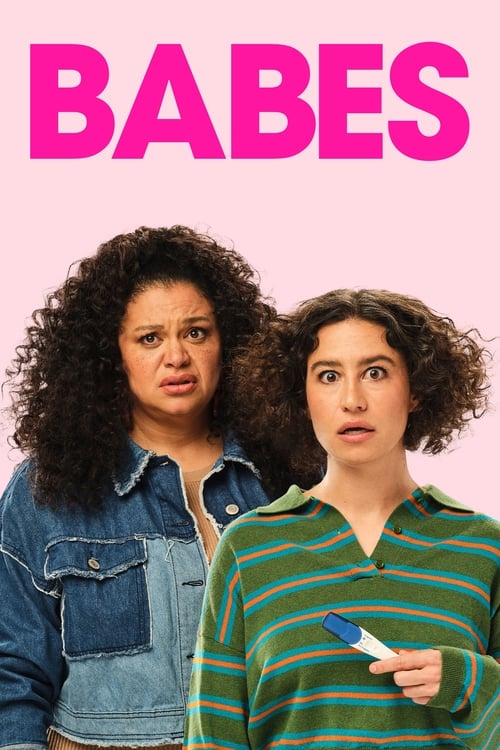
Pamela Adlon's comedy, written by Ilana Glazer and Josh Rabinowitz, follows Eden (Glazer), a single yoga teacher in Astoria who gets pregnant after a one-night stand, and her lifelong best friend Dawn (Michelle Buteau), a dentist on the Upper West Side with a husband, a toddler and a newborn. Most of the film is frank, gross-out humour about pregnancy, birth, breastfeeding and bodily fluids, wrapped around a story about a friendship strained when one friend's life fills up with family.
The messaging comes as banter. Race jokes recur: Dawn tells Eden she will be a white parent of a half-Black child, a genetic-screening scene riffs on whether testing is racist, and there are cracks about appropriation, Rachel Dolezal and the genocide behind Thanksgiving. Dawn's marriage to Marty (Hasan Minhaj) and Eden's night with Claude, the baby's father, are two interracial couples, which the rubric counts on sight. Abortion comes up once, framed as Eden's free choice, and the film is open and approving about casual sex and women's bodies.
What keeps the score low is that none of this drives the story, which is about friendship, money and exhaustion. There are no villains, the men are kind and involved, and the film often turns its jokes on progressive vocabulary: the friend who took offence at a sickle-cell test turns out to be a carrier, Eden polices her own slang as appropriation, and a male doula who wants to honour the female body is shown the door.
Score breakdown
Each category is scored 0 to 3: 0 absent or presence only, 1 brief, 2 recurring or plot-relevant, 3 central or dominant. Timestamps refer to the film's running time.
| Category | Score | What we saw |
|---|---|---|
| Content | ||
| A Race and ethnicity | 2 | Two interracial couples, which the rubric counts on sight: Dawn and Marty, the married couple seen throughout, and Eden's night with Claude, a Black man who is the baby's father. Race otherwise comes up as banter. Scored 2, not 3: neither romance is the film's main relationship, which is the friendship.
|
| B Gender and feminism | 1 | A women-centred comedy that celebrates pregnant and postpartum bodies, with a few lines about women being made to feel inadequate. There is no patriarchy critique, and the men are supportive.
|
| C Sexuality and gender identity | 1 | The film is frank and approving about casual sex, and defends Eden's one-night stand as a real connection that her friend later apologises for dismissing. One line declines to put a binary on the unborn baby. No LGBTQ characters or themes.
|
| D Power and systems | 1 | Two throwaway jokes about America's past. No institution is critiqued as oppressing a group.
|
| E Cultural and historical revision | 0 | An original story. |
| F Religion portrayal | 0 | Islam is not portrayed. |
| Treatment | ||
| G Antagonist coding | 0 | There are no antagonists beyond rude or awkward strangers, and nobody is coded by group. |
| H Didacticism | 1 | No lectures; a couple of lines state a point directly.
|
| I Message over story | 0 | The story leads; the jokes never steer the plot. |
| J Left-leaning politics framed as good | 1 | Abortion is presented as an unremarkable option and Eden's free choice, with no voice against it, and one joke treats loving a Republican leader as hormonal madness. It is brief.
|
How the number is reached
- Categories A to J add up to 7 of 30, which gives 2.5 (7 ÷ 30 × 10, rounded to the nearest 0.5).
- Counterweight −0.5: the film turns several jokes on progressive vocabulary: Dawn admits she took offence at a sickle-cell test and called her doctor a white devil, then turned out to be a carrier (0:34:21); Eden catches herself saying mamacita and calls it appropriation (0:36:06); and a male doula who wants to honour the female body is sent away as creepy (1:01:55); after Eden refused to put a binary on the baby and felt sure it was a boy, she is told it was always a girl (1:31:46).
- Final rating 2.0, mild.
Considered, scored 0
- Eden is Jewish, and the genetic-screening scene turns on it (0:34:01), without a message.
- Eden raising the baby on her own, without a message about single motherhood.
- Marty as a hands-on father who shares the strain of work and childcare (1:19:20), not framed as a role reversal.
- Eden and Dawn calling each other sisters and even spouses (0:53:01), a platonic friendship.
- A mixed New York cast, such as the Dominican nanny (0:48:41) and the clinic twins, shown without comment.
Evidence and confidence
Confidence: Medium. Full English subtitles (embedded track) and 104 frames sampled once a minute, the last four on the end credits. No gaps in the dialogue.
Category F definition: As in the rubric: Islam shown as a peaceful and tolerant religion, aligned with human rights, in a way that works as a corrective message.
Rubric version 1. Reviewed 18 November 2026.