Woke rating
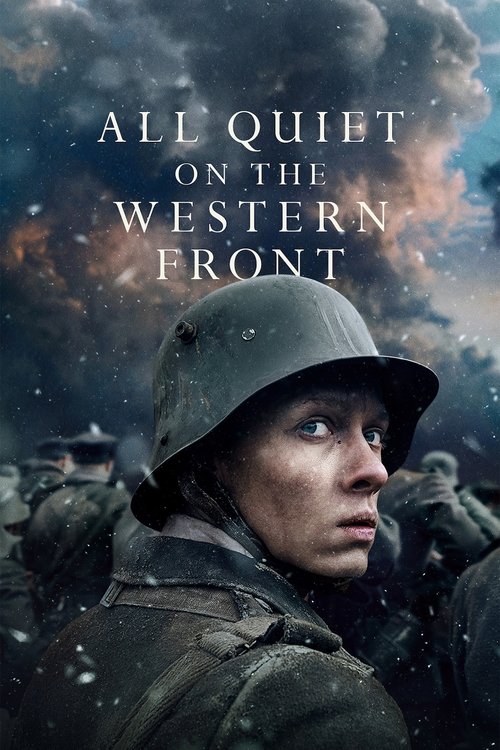
All Quiet on the Western Front
Mild
A harrowing German anti-war epic whose only politics are its scorn for militarist nationalism and the generals who spend young lives, with no identity messaging at all.
Edward Berger's German-language adaptation of Erich Maria Remarque's 1929 novel follows Paul Bäumer (Felix Kammerer), a 17-year-old who enlists with his school friends in spring 1917 after a patriotic send-off and is sent to the trenches of northern France. Eighteen months later, in November 1918, the film cuts between Paul, his older friend Kat and their comrades at the front and the German delegation under Matthias Erzberger (Daniel Brühl) negotiating the armistice at Compiègne. Most of the running time is combat, hunger and survival, with long stretches without dialogue.
The messaging is anti-war and aimed at the people who run the war. A headmaster sends the boys off as the Iron Youth of Germany; dead men's uniforms are washed, mended and handed to the new recruits; soldiers eat turnip bread while the general dines by candlelight; and that general sneers at the Social Democrats for selling off the fatherland while Erzberger, who has lost a son, pleads to stop the killing. The last act puts this contrast at the centre, through events the film adds to the novel.
The messaging is anti-war and aimed at the people who run the war. A headmaster sends the boys off as the Iron Youth of Germany; dead men's uniforms are washed, mended and handed to the new recruits; soldiers eat turnip bread while the general dines by candlelight; and that general sneers at the Social Democrats for selling off the fatherland while Erzberger, who has lost a son, pleads to stop the killing. The last act, invented for the film, has the general send his men into one more attack in the final quarter-hour before the armistice so the war can end in victory, shoot a soldier who refuses, and Paul die moments before eleven o'clock. Kat has already been shot by a French farmer's boy after the signing.
What keeps the score mild is that there is no race, sex, gender or sexuality messaging at all; the critique is of militarist nationalism and the officer class, the same anti-war stance as the novel. The general is given a personal motive, the victors are not flattered, and the boys are shown as eager volunteers rather than pure victims. Most of the points come from the film's additions to Remarque, which sharpen his anti-war case rather than add a new one.
Score breakdown
Each category is scored 0 to 3: 0 absent or presence only, 1 brief, 2 recurring or plot-relevant, 3 central or dominant. Timestamps refer to the film's running time.
| Category | Score | What we saw |
|---|---|---|
| Content | ||
| A Race and ethnicity | 0 | No race theme. The German and French soldiers are white, as fits the setting, and no interracial couple appears. |
| B Gender and feminism | 0 | No gender theme. Women barely appear: French farm women the soldiers flirt with, and Kat's wife through a letter read aloud. |
| C Sexuality and gender identity | 0 | No LGBTQ content. The soldiers' talk about sex is crude and heterosexual. |
| D Power and systems | 2 | The military establishment and the nationalism that feeds it are criticised throughout: the school sends boys to die, the army recycles dead men's uniforms, and generals eat well while sacrificing soldiers for pride. It is framed as an elite using up ordinary young men, but as an anti-war critique rather than one about race, sex or identity, and second to the horror of combat itself.
|
| E Cultural and historical revision | 1 | The film reshapes Remarque's novel around an added storyline, Erzberger's armistice talks, and a changed endingan invented last-minute attack in which Paul dies just before eleven o'clock on 11 November, where the novel has him die on a quiet day in October. The changes sharpen the indictment of the generals. No characters are recast by sex or ethnicity.
|
| F Religion portrayal | 0 | Islam does not feature. Christianity appears only in passing: a field Mass (1:33:03) and Kat's lament that God watches as they slaughter each other (1:42:31). |
| Treatment | ||
| G Antagonist coding | 1 | The film's human villain is a Prussian general who scorns the Social Democrats and would rather fight on than accept defeat, and the common soldiers are his victims. But he is given a personal motive, and most of the killing is done by the war itself, not by a demographic villain.
|
| H Didacticism | 1 | A few lines state the anti-war case directly, mostly in the armistice talks and closing titles. The trench scenes show rather than tell.
|
| I Message over story | 1 | The story mostly leads, but the last act stacks deaths into the war's final hours to drive the point home: Kat is shot after the signing and Paul dies in an invented attack minutes before the ceasefire.
|
| J Left-leaning politics framed as good | 2 | Patriotic nationalism, military honour and 'Kaiser, God and Fatherland' are shown as lies that kill a generation, and the man who blames the Social Democrats is the villain, while the civilian peace delegation is humane. This is the novel's anti-war stance applied to the politics of 1918, not a modern partisan programme.
|
How the number is reached
- Categories A to J add up to 8 of 30, which gives 2.5 (8 ÷ 30 × 10, rounded to the nearest 0.5).
- Counterweight −0.5: The film complicates its own framing. The boys are eager to enlist and cheer the call to march on Paris (0:11:15); the general is given a personal motive (1:31:11); the victors are not flattered, as Foch rejects any compromise and scoffs at fairness (1:45:29, 1:45:44); and the soldiers it sympathises with steal from French farms (0:38:47).
- Final rating 2.0, mild.
Considered, scored 0
- An all-white cast of German and French soldiers, as fits the period; a French farmer's slur 'Dirty Kraut' (0:38:47) is incidental.
- Brief scenes with French women (0:42:15, 0:54:55) and Franz's night with one of them (0:50:58), shown as soldier life.
- Kat, a cobbler, cannot read his wife's letters (1:50:57); the class gap between him and the schoolboy Paul is shown, not argued.
- A soldier's joke that monasteries hold only thieves and scoundrels (1:33:16), incidental.
Evidence and confidence
Confidence: Medium. The film has no English text subtitle track, and the Whisper translation of the German audio produced only filler. All dialogue therefore comes from an English subtitle track flagged as forced, which runs the length of the film and ends with the translators' credit, so it appears complete. 147 frames sampled once a minute. A few French lines (the farm women at 0:54:55, the dying French soldier at 1:26:05) may not be subtitled.
Category F definition: As in the rubric: Islam shown as a peaceful and tolerant religion, aligned with human rights, in a way that works as a corrective message.
Noted, not scored: The armistice scenes give a sympathetic hearing to the German complaint that the Allied terms are a diktat, not a negotiation (1:19:46), and Kat's longing to go home to his wife and have more children is shown warmly (1:50:18).
Rubric version 1. Reviewed 17 November 2026.