Woke rating
A Private Life
None or negligible
A French mystery-comedy about a psychiatrist who investigates a patient's death, with no progressive messaging: its wartime past-life visions and Jewish family background serve the puzzle and the comedy, not a point.
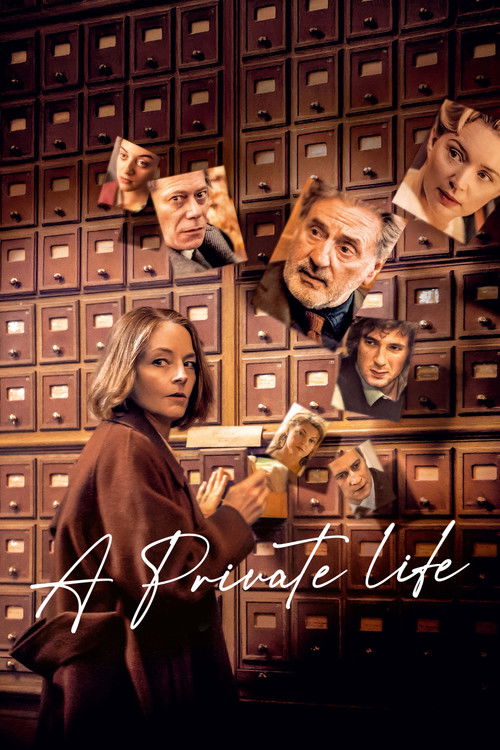
Rebecca Zlotowski's mystery stars Jodie Foster as Lilian Steiner, an American-born psychiatrist in Paris who learns that Paula, her patient of many years, has died of an overdose of the drug she prescribed. Sure it was not suicide, she starts her own investigation with her ex-husband Gabriel (Daniel Auteuil), an eye doctor, while sessions with a hypnotist send her back to what she takes for a former life with Paula in wartime Paris.
The material that might draw attention is historical and personal. Paula's family is Jewish, and in the hypnotic visions Lilian and Paula are Jewish musicians and lovers in occupied Paris, with Germans in the audience and the militia coming to round up the musicians (0:28:04, 1:05:12). Lilian tells the hypnotist that a remark about Freud is borderline antisemitic (0:31:30), and at a family dinner she announces that her son was a militiaman in that former life (1:15:00). The film plays all of this as character comedy: the hypnotist calls the accusation an insult and Lilian apologizes (1:00:48), and her family treats the past-life theory as nonsense (1:16:44).
The material that might draw attention is historical and personal. Paula's family is Jewish, and in the hypnotic visions Lilian and Paula are Jewish musicians and lovers in occupied Paris, with Germans in the audience and the militia coming to round up the musicians (0:28:04, 1:05:12). Lilian tells the hypnotist that a remark about Freud is borderline antisemitic (0:31:30), and at a family dinner she announces that her son was a militiaman in that former life (1:15:00). The film plays all of this as character comedy: the hypnotist calls the accusation an insult and Lilian apologizes (1:00:48), and her family treats the past-life theory as nonsense (1:16:44). The stalking turns out to be the work of Pierre, an ex-patient who wanted his tapes back (1:28:27); a small swastika by Lilian's doorbell is never explained (1:28:33). Paula's husband Simon has a second household in the country, but he tells Lilian that Paula helped her aunt Pearl die at Pearl's request and could not live with it (1:32:47), and the film leaves it as grief rather than an argument about assisted dying.
The score is zero because nothing is argued. The love affair in the visions is a device of the mystery and draws no comment about sexuality, the wartime persecution stays inside the visions with no present-day frame, and nobody lectures. The conflicts are about guilt, the limits of therapy, a divorced couple and a prickly mother and son.
Score breakdown
Each category is scored 0 to 3: 0 absent or presence only, 1 brief, 2 recurring or plot-relevant, 3 central or dominant. Timestamps refer to the film's running time.
| Category | Score | What we saw |
|---|---|---|
| Content | ||
| A Race and ethnicity | 0 | Race and ethnicity are not argued. Jewish identity appears as family background and dinner-table banter, and Lilian's accusation of antisemitism (0:31:30) is shown as her own rudeness, which she apologizes for (1:00:44). No interracial couple appears in the dialogue or the sampled frames. |
| B Gender and feminism | 0 | The lead is a professional woman, but gender is never made a point. Lilian's outburst that it is always the mother's fault (1:13:29) is part of a family row, and Paula's complaint about her harsh husband (0:50:25) is a patient's account in therapy. |
| C Sexuality and gender identity | 0 | In Lilian's visions she and Paula were lovers in a former life (0:28:25, 1:04:48), and Paula's daughter says her father thought Paula had fallen in love with Lilian (0:53:48). Both are threads of the mystery, with no comment on sexuality, so they count as presence. |
| D Power and systems | 0 | No institution is framed as oppressing a group. Lilian grumbles that the police never do anything (1:18:04), and a former colleague questions whether her prescribing was proper (1:02:36); both are personal frustration and professional doubt. |
| E Cultural and historical revision | 0 | An original story. No established characters or history are recast. |
| F Religion portrayal | 0 | Islam does not come up. Religion appears only as Jewish mourning customs at Paula's home and burial (frame 0:09:30, 0:32:40) and the folklore of the dybbuk (0:08:55, 1:17:30). |
| Treatment | ||
| G Antagonist coding | 0 | The suspects have personal motives and none is defined by a group are a grieving husband with a second household and an ex-patient angry about his fees, each with personal motives, and neither is defined by a group. |
| H Didacticism | 0 | No speeches carry a social message. The longest speeches are patients' sessions and the hypnotist's guided visions. |
| I Message over story | 0 | The story follows the mystery and Lilian's grief; none of its turns bends toward a message. |
| J Left-leaning politics framed as good | 0 | No political positions are argued, for or against. |
How the number is reached
- Categories A to J add up to 0 of 30, which gives 0.0 (0 ÷ 30 × 10, rounded to the nearest 0.5).
- No counterweight: There is no progressive messaging to mock or complicate.
- Final rating 0.0, none or negligible.
Considered, scored 0
- Lilian and Paula as lovers in a former life (0:28:25, 1:04:48), and Paula's husband's belief that she fell in love with Lilian (0:53:48): mystery devices, with nothing said about sexuality.
- Wartime persecution in the visions, with Germans in the audience (0:28:14) and the militia checking papers and rounding up Jewish musicians (1:05:12): history inside a hypnotic vision, with no present-day frame.
- Lilian calling the hypnotist's Freud remark borderline antisemitic (0:31:30), later called an insult and apologized for (1:00:48): played against Lilian.
- Dinner-table banter about who in the family is Jewish (1:14:31) and Lilian casting her son as a wartime militiaman (1:15:00), which the others treat as cruel nonsense (1:16:23): family comedy.
- A small swastika near Lilian's doorbell, mentioned once and left unexplained (1:28:33)when Pierre confesses to the break-in; he denies drawing it and it is never explained (1:28:33).
- The circumstances of Pearl's death, told as a family tragedySimon's account that Paula helped Pearl die at her request and could not live with it (1:32:47, 1:36:43): assisted dying shown as tragedy, neither argued for nor against.
- Gabriel telling their son that his parents' intimacy and sexuality are their own business (1:12:40), a line in a family quarrel.
Evidence and confidence
Confidence: Medium. Full English subtitles from the file's embedded track, covering the French dialogue and the few English scenes, and 107 frames sampled once a minute, the last few of them end credits. Many scenes are dark, so some background detail in the frames is hard to make out.
Category F definition: As in the rubric: Islam shown as a peaceful and tolerant religion, aligned with human rights, in a way that works as a corrective message.
Rubric version 1. Reviewed 18 November 2026.