Woke rating
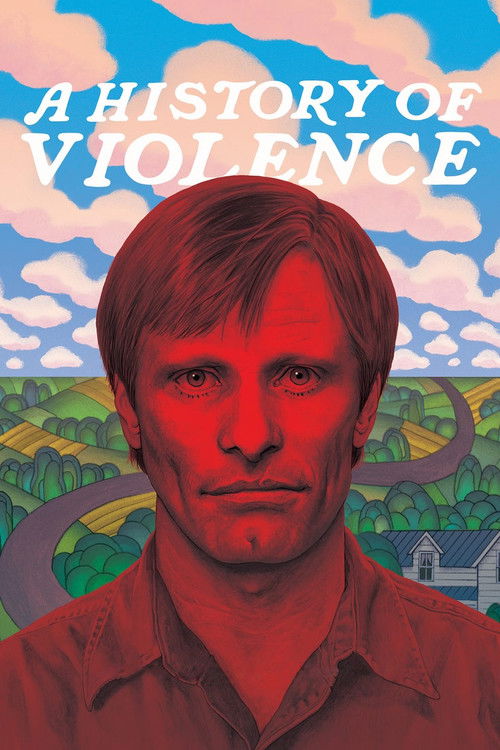
A History of Violence
None or negligible
A taut small-town thriller about a family man whose act of self-defence draws gangsters to his door, with no progressive messaging: its subject is violence and family, not politics.
David Cronenberg's adaptation of John Wagner and Vince Locke's graphic novel follows Tom Stall (Viggo Mortensen), who runs a diner in Millbrook, Indiana, and lives quietly with his lawyer wife Edie (Maria Bello) and their two children. When two drifters try to rob the diner, Tom kills them, the TV news turns him into an American hero, and a scarred Philadelphia gangster, Carl Fogarty (Ed Harris), turns up insisting that Tom is really a man called Joey Cusack.
There is little here for the rubric to find. A school bully throws homophobic slurs at Tom's son Jack, who turns them back on him with deadpan sarcasm; Edie is a capable lawyer who faces Fogarty down herself; reporters chase the 'American hero' angle. None of it is framed as commentary. The film's subject is violence: whether a man can leave it behind, and how it spreads to his son and his marriage once the past catches up with the family.
There is little here for the rubric to find. A school bully throws homophobic slurs at Tom's son Jack, who turns them back on him with deadpan sarcasm; Edie is a capable lawyer who faces Fogarty down herself; reporters chase the 'American hero' angle. None of it is framed as commentary. The film's subject is violence: once Tom admits he was Joey, a Philadelphia killer who reinvented himself, the story turns on Edie's horror, Jack's own outburst of violence and Tom's trip to Philadelphia to face his brother Richie (William Hurt), and it ends with a wordless, uncertain family dinner.
The score stays at zero because nothing is argued. The villains are criminals with personal grudgespersonal grudges: Fogarty's lost eye and Richie's stalled career, not stand-ins for a group; the local sheriff is decent and protective; small-town life and the family are drawn with affection, and the film's doubts about violence are not tied to any political side.
Score breakdown
Each category is scored 0 to 3: 0 absent or presence only, 1 brief, 2 recurring or plot-relevant, 3 central or dominant. Timestamps refer to the film's running time.
| Category | Score | What we saw |
|---|---|---|
| Content | ||
| A Race and ethnicity | 0 | Race never comes up. The town and the cast are almost entirely white, and no interracial couple appears in the dialogue or the sampled frames. |
| B Gender and feminism | 0 | Edie is a lawyer who confronts Fogarty and gets a restraining order herself (0:47:53, 0:51:27), but her strength is shown, not argued, and gender is never a theme. |
| C Sexuality and gender identity | 0 | No LGBTQ characters or themes. A bully calls Jack a homophobic slur and Jack mocks him by agreeing (0:12:56, 0:13:01); it is schoolyard abuse, not commentary. |
| D Power and systems | 0 | The villains are organised criminals, and the local sheriff is shown as decent and protective of the family (0:34:50). TV reporters chasing the 'American hero' story (0:27:00) are a light touch of media satire, not a critique of institutions as oppressors of a group. |
| E Cultural and historical revision | 0 | Adapted from a 1997 graphic novel. No established characters or history are recast to carry a message. |
| F Religion portrayal | 0 | Religion plays no part beyond a customer's parting 'see you in church' (0:22:15). |
| Treatment | ||
| G Antagonist coding | 0 | The gangsters are driven by personal grudges over the pastpersonal grudges: Fogarty wants revenge for the eye Joey took (1:21:30), and Richie for the career Joey cost him (1:22:21), not defined by a demographic or ideological label. |
| H Didacticism | 0 | No speeches carry a social message. Jack's sarcastic reply to the bully about establishing his alpha-male standing (0:13:16) and Tom's line that the family does not solve problems by hitting people (0:50:34) are about violence, which falls outside the rubric. |
| I Message over story | 0 | The story is a tight thriller about a man's pasta hidden past, and none of its turns bends toward a message. |
| J Left-leaning politics framed as good | 0 | No political positions are argued. Small-town life, the family and the local police are shown sympathetically, and the film's questions about violence are not framed as left or right. |
How the number is reached
- Categories A to J add up to 0 of 30, which gives 0.0 (0 ÷ 30 × 10, rounded to the nearest 0.5).
- No counterweight: There is no progressive messaging to mock or complicate.
- Final rating 0.0, none or negligible.
Considered, scored 0
- A small-town cast that is almost entirely white, shown without comment.
- The bully's homophobic slurs at Jack (0:12:56, 0:20:54) and Jack's mocking reply, used as schoolyard abuse rather than commentary.
- Edie as a lawyer who stands up to Fogarty (0:47:53), shown, not argued.
- TV coverage of the 'American hero' (0:27:00, 0:27:56), light media satire with no group framing.
- Tom telling Jack the family does not solve problems by hitting people (0:50:34), part of the film's theme of violence, which the rubric does not score.
- A late scene in which an argument on the stairs turns into rough sex (1:07:42), about the marriage's crisis rather than a message about gender.
- A gangster'sRichie's jibe that Tom has bought into the American dream (1:21:44), a character's sneer rather than the film's thesis.
Evidence and confidence
Confidence: Medium. Full English subtitles from the embedded dialogue track, and 96 frames sampled once a minute. The last stretch of the film before the credits has no dialogue (after 1:27:21); the sampled frames cover it.
Category F definition: As in the rubric: Islam shown as a peaceful and tolerant religion, aligned with human rights, in a way that works as a corrective message.
Noted, not scored: Armed self-defence is shown as effective: the town hails Tom as a hero (0:25:22) and Edie fetches the shotgun when he fears an attack on the house (0:39:38). The film weighs the cost of that violence to the family rather than celebrating it.
Rubric version 1. Reviewed 17 November 2026.